Where I'm from US citizen · no visa, no sponsorship New York time Mar–Nov · 1 h ahead in winter 100 × 35 miles · 3.2 million people
Drag to move · press Turn, then drag to rotate · pinch or scroll to zoom · tap anything
Scroll to travel · drag to look · point at anything
Javier Elías Crespo — AI Builder · Solutions & Implementation

Self-taught builder shipping real AI systems.

I use Claude Code every day to take ideas end to end — and four years in luxury service and insurance taught me the other half: explaining the result to someone non-technical in words they actually use.

I built this whole portfolio with Claude Code, the island and everything on it. How it was made, bugs and all ↓

Puerto Rico · US citizen · fully bilingual English / Spanish
CareerOS · run of Oct 23, 2026
16,129listings scanned
341employer job boards tracked, about 300 read daily
200job pages read in full
Dailyruns on its own
How it's built · the build log
157of its 158 cloud runs passed
886test checks in the live engine, all passing (744 in the public copy)
125commits I directed
13,765lines of Python in the live engine: I decided what each part does and verified it by running it

↓ Puerto Rico, one building per project, sunrise to sunset

01 — About

Industrial Design taught me that form has to earn its function. I build the same way now, in software: automations that run on their own every day, check their own work, and tell a person in plain words what they found.

I build like it has to run without me watching: preflight checks, crash handling, a human tap before anything real happens. Things have broken, collapsed even, and every time I came back, found the bug, and fixed it. Two years as a butler at The St. Regis and two years at Optum (UnitedHealthcare) gave me the other half of the job, explaining technical things to people in the words they actually use.

Fig. 01 — Colmado · the corner store
Complete · live

Food Pantry Weekly Digest

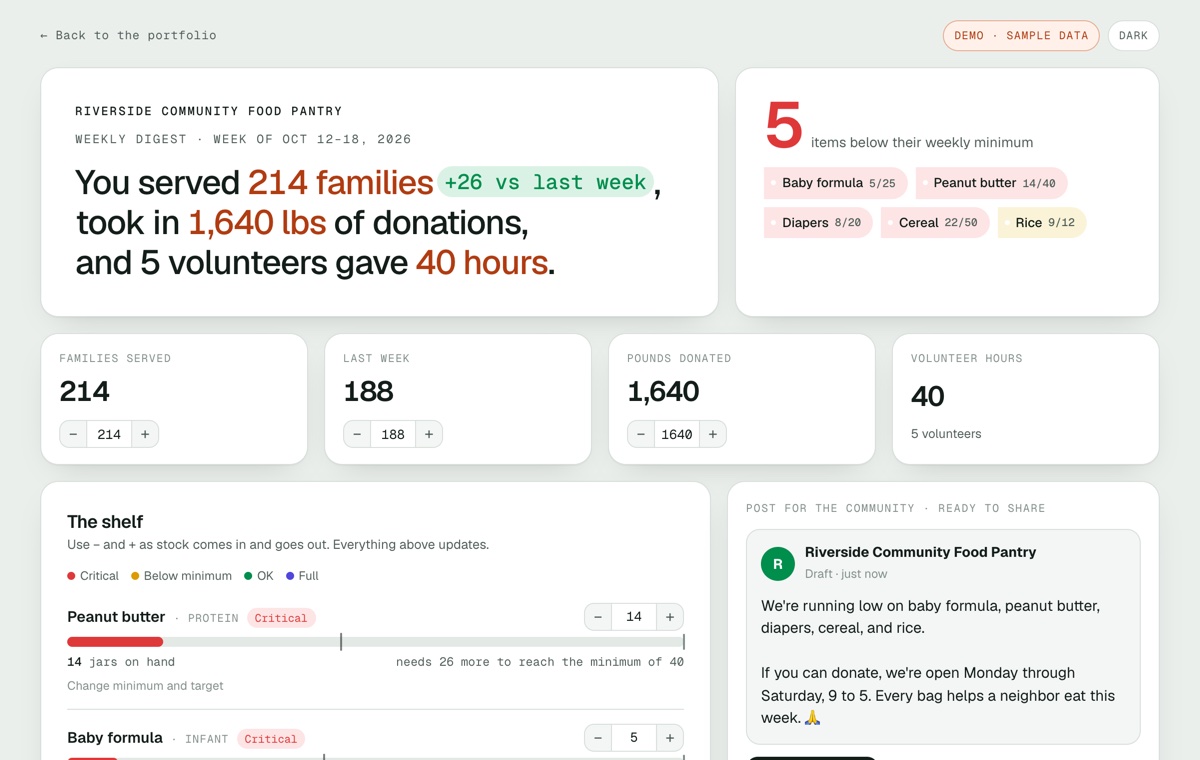
A working demo of what I'd build for a nonprofit. It turns a food pantry's messy weekly numbers into a plain-English brief anyone can act on: what's stocked, what's critically low, and a ready-to-post ask to the community. Sample data, no real org's information; edit anything and the digest recomputes live.

The whole point is legibility: AI making a small organization's operations legible to the non-technical people who run it — the exact thing years of service and sales taught me to do.

The Food Pantry Weekly Digest: families served, donations, volunteer hours, a ready-to-post community ask, and what is running low.
The story · why a colmado
Intention
Take something technical and make it make sense to a normal person who just needs to feed their neighbors this week. It's part of a longer mission of mine: places of food and water for people who have neither.
What happened
Built and published in July 2026, with food security as the focus. One self-contained page on sample data. I tried to break it on purpose before publishing it, and it held. In October 2026 I redesigned it as an operations board.
What I learned
A demo has to say it's a demo. It runs on sample data and says so everywhere, because for a small nonprofit, trust is the whole product.
The symbol
The corner colmado is where a barrio finds out what's on the shelf and what's running low. This digest does the same for a food pantry, and its door is open: anyone can walk in and try it.

Fig. 02 — Central · an old sugar mill
Ran every week, June to September 2026

XPT OS

An outreach engine I built for a personal search where the best opportunities are never posted; they move through people. Every week a cloud routine searched over a dozen scattered sources (property agencies, buyer's agents, local connectors), scored each lead against a weighted rubric with hard vetoes, deduped against a permanent ledger so no one was contacted twice, and sent me drafts on Telegram. Nothing went out until I approved it.

The cloud sandbox blocked outbound network calls, so I used a git commit as the message queue to get work off the box.

Shipped · ran 17 times, June–September 2026 · 41 emails sent, 4 replies
The story · why a sugar mill
Intention
The best openings in that search were never posted; they came through people. So I built a machine to find those people and reach them one at a time, with my approval on every message.
What happened
June to September 2026: 17 weekly runs without a miss. I sent 41 emails between June 22 and July 22 and got 4 replies, one asking for my profile. After July I stopped sending; the machine kept running on its own schedule until late September.
What I learned
Job boards fill a small share of openings; most move through trust. And if a schedule matters, own the clock yourself and let the platform own only the work.
The symbol
Puerto Rico's sugar mills turned raw cane into something people could use. This one turned scattered leads into a short list of real people, every week, and its machinery never missed a run.

Fig. 03 — Varillas · rebar for the second floor
v1 shipped, then rebuilt from what the data showed

Shipped · what it taught me

Web OS

A five-stage sales pipeline in software (source → design → outreach → CRM → close) that finds local businesses with weak websites, builds them a better one, and manages the outreach. ~2,750 lines of Python across 21 scripts plus a Next.js build starter.

The hard part wasn't scraping, it was encoding judgment: which leads are worth it, an explicit anti-slop design bar, and a verify-before-send gate added after an early run bounced ~17%.

Ran live email campaigns, June 2026 · rebuilt in July around phone calls when the data showed email couldn't reach most businesses
The story · why rebar
Intention
Find local businesses whose websites were hurting them and give them a site that looks like it cost $10,000, at a price a small business can pay.
What happened
Email campaigns ran in June 2026; one hit 17% bounces and paused itself. In July I rebuilt it around phone calls and a simpler $550 site. My first referred client, a small business in Vieques, got a free practice site.
What I learned
Verify every address before sending, never a raw scrape. Email can't reach businesses with no website: only 1 in 79 listed an address. And read every AI-built page against its source: one tool invented fake reviews.
The symbol
All over Puerto Rico, rebar sticks out of flat roofs because the first floor was built to carry more. Version 1 is that first floor, and its lessons carry what I've built since.

Fig. 04 — Toldo azul · a blue tarp after Hurricane María
It fell, and its fall wrote my rules

Shipped · what it taught me

ELiaS

A 9-agent personal AI operating system, built the way I'd want it if something real depended on it. ~9,700 lines: a shared resilience layer (preflight that exits clean instead of crash-looping, crash wrapper with alerting, Keychain secret fetch), a 4-provider LLM failover cascade, and a dead-man's switch that alerts from off the machine so a dead Mac still raises an alarm.

A hard rule: machine-written knowledge is quarantined from anything the system tells me about myself. Every real-world action needs a human tap.

9 agents ran unattended, May–June 2026 · the resilience rules I build by came from how it failed
The story · why a blue tarp
Intention
Before anyone trusts an autonomous AI system with real work, someone has to run one unattended for months and find out what actually breaks. I ran it on myself first.
What happened
Nine agents and about 9,700 lines ran on my Mac. On June 13, 2026, an auto-commit plugin removed all 60 files from the vault in ten minutes. I recovered the code from git; the system never ran again.
What I learned
Monitoring that lives inside the thing it monitors isn't monitoring: the dead-man's switch died with the man. Every rule I build by now, preflight checks, crash alerts, an alarm from off the machine, came from how this one fell.
The symbol
After Hurricane María, blue tarps covered the island's roofs while people rebuilt. A blue tarp means it fell and someone's still here. The rafters going up are the rules I took from the fall.

Fig. 05 — Arecibo · the dish still stands
Knowledge layer kept · still answers questions

Shipped · what it taught me

2nd Brain OS

A knowledge base a language model maintains as its own memory: an Obsidian vault where Claude Code is librarian and writer, with a three-tier context budget and a hand-written task router that answers any question in a capped number of reads.

A ground-truth file the model is forbidden to exceed, and autonomous writes tagged unverified, so machine claims stay separable from human fact. 176 agent-authored pages, backed up to GitHub through July 2026.

Kept · 176 pages written by agents, last backed up July 2026 · scheduled layer retired
The story · why Arecibo
Intention
Give a language model a long-term memory it keeps up on its own, without letting it rewrite the truth, because a model with write access will confidently corrupt what it touches.
What happened
87 commits between May and July 2026, and 176 pages written by agents. The knowledge layer still answers questions, but it stopped growing in July. The scheduled agents went down in mid-May, failing on missing script paths, and the vault says so.
What I learned
A system that documents its own automation has to verify that documentation, or the documentation becomes the most confident liar in the vault.
The symbol
The great dish at Arecibo still stands; the platform that hung above it fell in 2020. The knowledge is the dish. The agents were the platform.

Fig. 06 — Kiosko · Rincón at sunset
Live on Gumroad since May 2026

Shipped · what it taught me

Claude Cowork Skills

Seven Claude skills for content creators who don't code, in English ($39) and Spanish ($29), published on Gumroad. They draft newsletters, threads and YouTube metadata, batch a week of posts, repurpose one piece five ways, find reply opportunities, and learn the creator's voice. They work in Claude Cowork, Claude Projects and Claude Code.

The Spanish edition isn't a translation: it was rewritten for Latin American creators, a market where I'd checked and found no direct competitors.

Live on Gumroad in English and Spanish since May 12, 2026 · EN $39 · ES $29
The story · why a kiosko
Intention
Turn what I know about Claude into tools people who don't code can use, with a Spanish edition for creators nobody was building for.
What happened
Both editions went live on Gumroad on May 12, 2026, and the listings are still up. On May 27 I moved on to bigger builds, before running the promotion I had planned.
What I learned
Listing a product isn't selling it. Building took days; reaching people is the real work, and it needs its own plan.
The symbol
Rincón's beach kioskos open every afternoon, lights on, ready for whoever walks up. This one has seven packages on the counter, in two languages.
02

Also built

FrecuencIA OS Claude Code · content system

The command center for my personal content project: a context-engineered Claude Code workspace that loads its full context with one launch alias. Its content folder is a reel production system: a story bank, a ship-order reel queue, and a voice-memo ritual where Claude transcribes and formats but never writes in my voice.

Built July 2026 · my story bank and reel queue live here

XPRST macOS · Electron

A macOS dictation app that never steals focus. Hit a hotkey anywhere, speak, and the transcript lands on your clipboard without the app you're in ever knowing it happened. Whisper via Groq, 3,157 lines. The hard part was Electron window management: a pill UI built to be un-focusable and click-through.

Runs from source on my Mac

MASK OS Claude Code · method manual

A Claude Code workspace that runs structured self-inquiry sessions to find the subconscious "mask" under a stuck pattern, using a 203-line method manual distilled from Peter Crone's public work. One thread per session: a specific moment, event versus story, the belief, a yes/no test, acceptance. It stops on crisis signals, never gives advice, and never speaks as Crone. Not therapy.

Personal use · sessions run August 2026 · records kept private

Client Workspace Template Claude Code · workspace

The workspace I start every project from: five gates from spec to ship, written security rules with a secret-scan command to run before every commit, and a clone script that copies tracked files only, wipes plans, outputs and project learnings, and starts fresh git history. CareerOS and MASK OS were built from it.

In use · CareerOS and MASK OS were built from it

Implementer Kit Bash · launchd · Claude Code

A kit for scheduling founder automations on Claude Code. Each one is a plain-English task file piped through Claude and delivered to Telegram. A shared engine (Keychain secrets, preflight, notify then exit cleanly on failure), a launchd scheduler and a daily heartbeat. 286 lines, two templates: an ops digest and an inbox-triage stub.

Built June 2026 · engine, scheduler, heartbeat and two templates

VA OS Retell · n8n · voice agent

A voice and WhatsApp receptionist system for local service businesses: Retell voice agent, Cal.com booking, WhatsApp Cloud API, n8n and a simple CRM. For a Miami car-detailing business I built a bilingual Retell demo agent (a demo, not a paid client) with call transfer, calendar booking and a recording disclosure, and rebuilt its knowledge base from the business's own site after I caught invented prices.

Working bilingual voice-agent demo, June 2026

AIOS Command Center Next.js · prototype

A local dashboard to see my AI agents at a glance: what ran, what failed, what it produced. The cockpit for ELiaS, in Next.js and React.

Phase 1 prototype · two working views, May 2026

Isla, this portfolio Three.js · Claude Code

This page. Puerto Rico built block by block in code, no 3D model files: one building per project in its true condition, a day that passes as you scroll, culture across the island, real coquíes and plena, a switch to Spanish, and the whole island to explore at the end.

Made entirely with Claude Code · verified on desktop and phone
03

How I made this island

I built this whole portfolio with Claude Code. Every block, building, person and sound on the island is code: no 3D model files. I directed every piece and judged it by eye, Claude Code wrote it, and nothing went in until it ran in a real browser, on a desktop and a phone.

2 days · 25 versions · ~1,350 lines of code · 0 model files

It started as Greek temples. The first version put an acropolis on the island, one temple per project. I scrapped it for Puerto Rico itself: a barrio, a colmado, a sugar mill, a blue tarp.

What broke on the way, and how it got fixed

  • Everyone had one leg. A box drawn from right to left came out empty, so every person, drummer and vejigante lost the left leg. It showed on Benito first.
  • Parrots bigger than houses. The first cotorras had wings wider than a building, and the plastic chairs stood 1.6 m tall. People and props were rebuilt at true scale: a person is about 1.75 m beside a 2 m door.
  • Coquíes that never got louder at night. The line that turned them up was sitting inside a comment, so it never ran.
  • Rain that wasn't there. The shower over El Yunque switched itself off 40% of the time, and vanished completely with Reduce Motion on.
  • Taps that did nothing on a phone. Lifting a finger counts as "leaving" the screen, and that hid each explanation the instant it appeared. Caught by tapping an emulated iPhone with real touch events.
  • Puerto Rico sideways. On phones the final view showed the island turned on its side. Now it ends north-up, like a map.
  • Silence on iPhone. The silent switch muted the coquíes until the page asked to play as media, like a video.
  • An engine that broke while looking fine. A stray line broke the code twice while the browser kept serving the old copy. Now every change is syntax-checked and versioned before it loads.
  • A project card that told the wrong story. XPT OS said 18 drafts and 1 email. Its own records said 41 sent and 4 replies. Every claim on this page was checked against its source files.
  • Music we weren't allowed to use. The bomba recordings I loved most were all rights reserved. The plena you hear is one whose owner allows reuse, credited at the bottom.

That's how I build: make it, break it on purpose, fix what it shows me, and keep the receipt.

04

Experience

→Optum (UnitedHealthcare) — Licensed Customer Service & Sales Representative · 2022–2024

Two years supporting people through health-insurance decisions: taking high-stakes, genuinely confusing information and making it plain enough for a frightened person to act on. The whole job was translation, under time pressure, with real consequences for getting it wrong.

→The St. Regis Bahia Beach Resort — Butler · 2018–2021

High-touch service for demanding guests: reading what someone needs before they can articulate it, holding fifteen competing priorities without dropping one, and handling sensitive situations with discretion. Implementation work, before I had the word for it.

→BFA, Industrial Design · fully bilingual English / Spanish

Design taught me that form has to earn its function. Bilingual since birth, spoken and written — which matters for any team serving customers across the Americas.

05

How I build

→Verification over vibes

Nothing ships because it looks done. It ships when it ran and there's a receipt.

→Built to survive handoff

Preflight, crash handling, approval gates. Someone else should be able to own it.

→Honest about what's broken

Dormant is dormant. A projection is a projection. The defect list is part of the work.

Coquí recording: Gabriel Leite, Río Grande, xeno-canto XC996296, CC BY-NC-SA 4.0, trimmed into a loop under the same license. Plena recording: Reilly Gault, “Plena Puertorriqueña”, CC BY 3.0, trimmed into a loop.

This portfolio was made entirely with Claude Code, in Puerto Rico, and verified before shipping. Javier Elías Crespo.

This portfolio was made entirely with Claude Code.

Drag to move it · pinch to zoom · tap anything to learn what it is↑ Back to the top